





Regional cooperation11 May 2024

QAA · Since 2006
Quality & excellence
Quality & excellence
in education
The national reference for accrediting Libya's educational institutions and equating academic qualifications since 2006.
The Centre in numbers
45
accredited institutions
Universities, colleges, institutes & schools
{{ activeProgs }}
active accredited programmes
Across institutional and programmatic accreditation
20
years of institutional work
Since its founding in 2006
Established under Resolution No. (164) of 2006
About the Centre
One of the main pillars for reforming
One of the main pillars for reforming
and developing education in Libya
The Centre was established in 2006 as the "Centre for Quality Assurance and Accreditation of Higher Education Institutions". Its mandate was expanded in 2009 to include schools, universities and higher technical institutes, and its current name was settled under Education Law No. (18) of 2010. Today the Centre carries out its work in line with its approved organisational structure, as the national body responsible for spreading a culture of quality, granting accreditation, and equating academic qualifications.
Resolution (164) of 2006Establishment
Resolution (129) of 2009Expanding the mandate
Law (18) of 2010Adoption of the current name
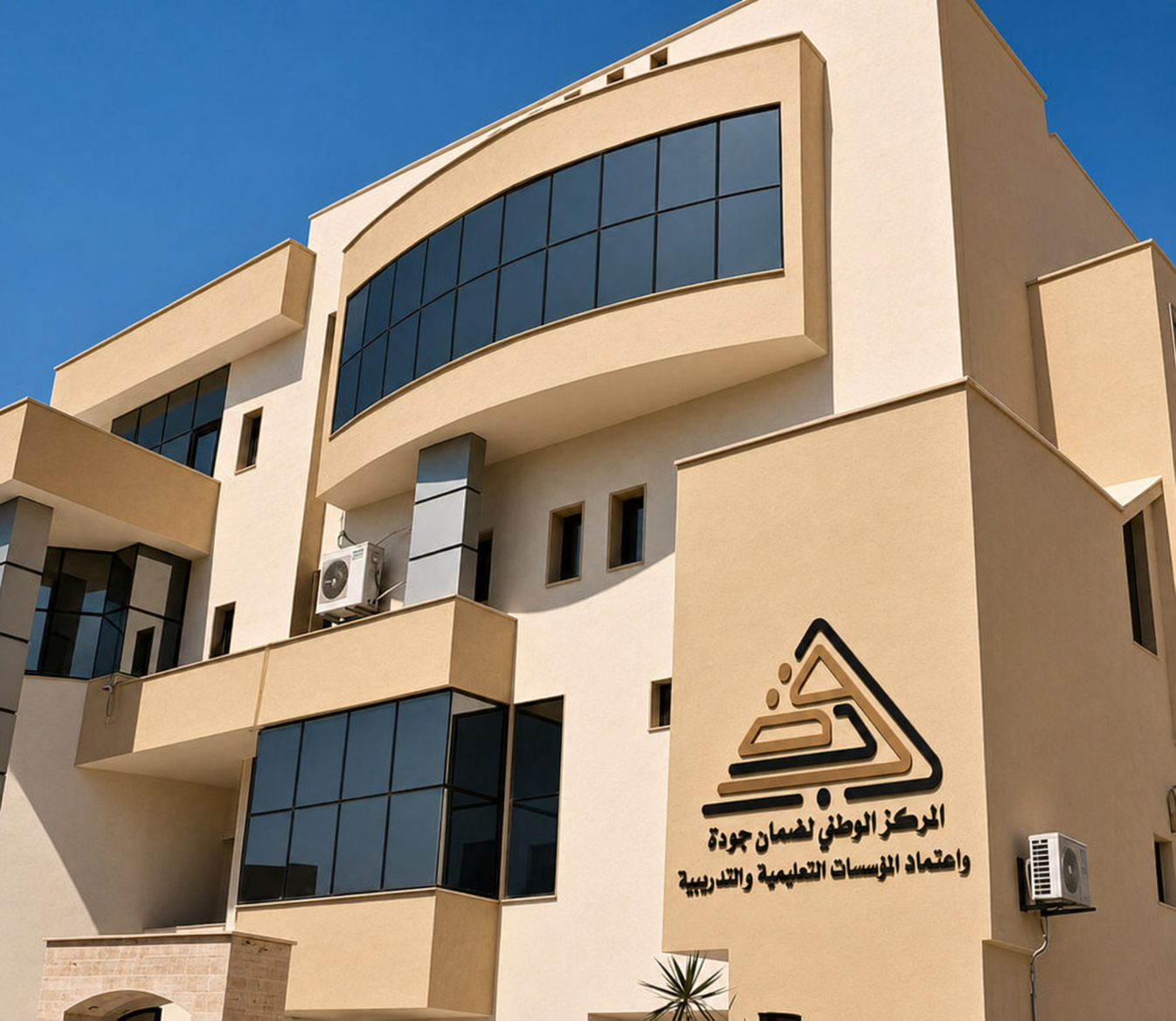 The Centre's headquarters
Bin Ashour – Tripoli – Libya
20 years serving quality
Accredited Institutions
A trusted national accreditation register
Institutions that underwent external audit by teams formed under the Director-General's decision and obtained institutional, or institutional and programmatic, accreditation.
News & Activities
Latest from the Centre
Latest updates
Training6 May 2024
Training programme launches at Sabha University under the 2024 Training Plan
Qualification Equivalency30 April 2024
Fourth Meeting of the Academic Qualification Equivalency Committee


About Us
The National Centre for Quality Assurance and Accreditation of Educational and Training Institutions is one of the main pillars for reforming and developing education in Libya. It aims to build and develop a comprehensive national system for the evaluation, quality assurance and accreditation of all educational and training institutions — public and private — to advance the educational and training process and reach the highest levels of quality, efficiency and excellence, guided by international standards.
It is the body responsible for spreading and strengthening a culture of quality, and for setting and developing local accreditation standards (institutional/programmatic) aligned with international benchmarks. It is authorised to accredit educational and training institutions to improve their outcomes and enhance their competitiveness locally and internationally, and is responsible for recognising foreign educational institutions and equating the academic qualifications they award with their national equivalents.
Our Mission
The Centre seeks to apply and develop a comprehensive system for the quality assurance and accreditation of educational and training institutions, and to assure the quality of their outcomes in line with international standards and best practices for excellence, in fulfilment of the Sustainable Development Goals.
Our Goal
The Centre aims to build and develop a comprehensive national system for the evaluation, quality assurance and accreditation of all educational and training institutions, public and private.
Our Values
Commitment
Empowerment
Mastery
Excellence
Transparency
Objectivity
Strategic Objectives
1Continuing to spread a culture of quality, continuous improvement, evaluation and accreditation, and providing guidance manuals and technical and training support
2Providing advice and guidance to institutions that have not met the required quality levels in the elements to be accredited
3Establishing and applying the foundations, standards and conditions of academic evaluation and accreditation, and amending and developing them
4Publishing accreditation information and data for awareness, media and research purposes and making it available to entities and individuals
5Cooperating with Arab and international accreditation and quality-assurance bodies
6Encouraging a spirit of competition among educational and training institutions to improve the educational process by recognising and recommending rewards for them
7Informing society and its institutions about the state of educational and training institutions through detailed periodic reports
8Designing and delivering training programmes for the Centre's staff in line with the nature of their work
9Developing the National Qualifications Framework for higher education, ensuring alignment with qualifications awarded by comparable institutions outside Libya
10Developing e-administration across the Centre's administrative, financial and service operations
The Centre's mandate
The Centre designs, develops and applies a comprehensive system for the evaluation, quality assurance and accreditation of educational institutions, in order to advance the educational process toward efficiency and excellence — enabling institutions to raise the calibre of their graduates and drive research and knowledge contributions that meet development needs and competitiveness in local, regional and international labour markets. This is achieved by promoting a culture of planning and self-assessment, proposing general quality policies for the auditing and accreditation of educational and training institutions within an integrated internal system that ensures competitive educational outcomes, and through rigorous processes for equating academic and foreign qualifications.
Establishment of the Centre
The Centre was established under General People's Committee (formerly) Resolution No. (164) of 2006 as the "Centre for Quality Assurance and Accreditation of Higher Education Institutions". Its mandate and name were amended by Resolution No. (129) of 2009 to the "Centre for Quality Assurance and Accreditation of Educational Institutions" to include schools, universities and institutes. Its current name, the "National Centre for Quality Assurance and Accreditation of Educational and Training Institutions", was adopted under Education Law No. (18) of 2010, and the Centre currently exercises its mandate in line with its organisational structure approved by Resolution No. (52) of 2015.
Resolution (164) of 2006Establishment
Resolution (129) of 2009Expanding the mandate & name
Law (18) of 2010Adoption of the current name
Resolution (52) of 2015The organisational structure
Is your institution accredited?
Check accreditation status and decisions in the interactive directory.
Administrative history
Former Directors-General
Founder
Prof. Idris Ahfida Al-Mabrouk
Jun 2006 – Mar 2010He assumed the post of Chairman of the Centre's Management Committee under General People's Committee Resolution No. (303) of 2006.
Former Director-General
Prof. Mohamed Abdullah Al-Kabir
Mar 2010 – Dec 2012He assumed the post of Director-General under a Minister of Higher Education and Scientific Research decision in 2010.
Former Director-General
Dr. Abdullah Abdel-Jalil Mohamed
Dec 2012 – Nov 2013He assumed the post of Director-General under Minister of Higher Education and Scientific Research Resolution No. (1265) of 2012.
Former Director-General
Dr. Osama Nour El-Din Al-Fazzani
Nov 2013 – Apr 2018He assumed the post of Director-General under Minister of Higher Education and Scientific Research Resolution No. (769) of 2013.
Former Director-General
Dr. Mohamed Ezz El-Din Ben Othman
May 2018 – Apr 2019He assumed the post of Director-General under a Minister of Higher Education and Scientific Research decision.
Former Director-General
Prof. Mohamed Nouri Al-Atouq
Apr 2019 – May 2021He assumed the post of Director-General under Presidential Council Resolution No. (649) of 2019.
Introduction
Libya launched numerous initiatives and programmes to develop and raise the quality of higher education. These saw the issuance of many regulations, standards and procedures defining the criteria and controls for the quality assurance and accreditation of educational institutions.
The most important of these stages and initiatives culminated in the establishment of the Centre, and included adopting and issuing numerous standards, procedures and guides related to the quality assurance and accreditation of educational institutions at all levels — prepared and developed through technical committees and working groups, with the participation of dozens of faculty members and distinguished national experts.
Phase One
The Founding Phase
2004
Organising the higher-education sector
On 1/9/2004, General People's Congress Resolutions No. (11) and (14) of 2004 assigned the administration of the higher-education sector to a General People's Committee, followed by Resolution No. (176) of 2004 on organising the administrative apparatus of higher education, which included establishing a department to monitor the quality of higher education.
2005
Central Committee for Higher Education Quality Assurance
The Secretary of the General People's Committee for Higher Education (formerly) issued Resolution No. (80) of 2005 forming a central committee to develop a programme for the requirements of a quality and accreditation system in higher-education institutions; its work culminated in drafting the "National Document for Quality Assurance of Higher Education Institutions in Libya".
Chaired by Dr. Bashir Husni Zaghwan; members: Dr. Al-Tayeb Al-Bakoush, Dr. Tawfiq Ajal, Dr. Osama Al-Fazzani, Dr. Ahmed Shambesh, Dr. Milad Al-Taher, Dr. Idris Al-Mabrouk, Dr. Suleiman Al-Khoja, Eng. Khalifa Al-Aswad2006
Technical Committee for Extracting Standards
Resolution No. (04) of 2006 formed a technical committee whose key tasks were to extract quality standards from the National Document and propose an implementation mechanism; it prepared a draft guide for the quality assurance and accreditation of higher-education institutions and a proposal to establish the Centre.
Chaired by Dr. Bashir Husni Zaghwan; members: Dr. Al-Tayeb Al-Bakoush, Dr. Idris Al-Mabrouk, Dr. Tawfiq Ajal, Dr. Osama Al-Fazzani, Eng. Khalifa Al-Aswad2006
Establishment
General People's Committee (formerly) Resolution No. (141) of 2006 included an administrative structure comprising a "Department of Research and Quality Control in Higher Education". Resolution No. (164) of 2006 then established the Centre for Quality Assurance and Accreditation of Higher Education Institutions as an independent legal entity with its own budget, abolishing the Department of Research and Quality Control.
Phase Two
The Launch Phase
2006
Assigning the Centre's management committee
General People's Committee (formerly) Resolution No. (303) of 2006 assigned a management committee for the Centre chaired by Dr. Idris Ahfida Al-Mabrouk, who opened the founding phase by adopting the organisational and administrative structure and staffing plan and selecting the first cohort of founding staff through merit-based interviews — enabling the Centre to complete its establishment, settling-in and equipping in record months.
2007
Quality Assurance Advisory Committee
The Secretary of the Management Committee issued Resolution No. (32) of 2007 forming the Centre's Quality Assurance Advisory Committee, whose core tasks included reviewing, developing and issuing the guide for the quality assurance and accreditation of higher-education institutions and the institutional and programmatic evaluation models.
Chaired by Dr. Tawfiq Al-Taher Ajal; members: Dr. Osama Al-Fazzani, Dr. Mohamed Al-Tawil, Dr. Mohamed Al-Tabouli, Dr. Abdel-Salam Al-Mathnani, Dr. Fawzi Karim, Dr. Fathi Abu-Zakhar, Dr. Diaa El-Din Abu-Hadra, Dr. Abdel-Aziz Al-Zarqani, Mr. Ali Al-Zain (rapporteur)2007
Adoption of the quality-assurance and accreditation guide
The management committee's efforts culminated in General People's Committee for Higher Education Resolution No. (23) of 2007 adopting the guide for the quality assurance and accreditation of higher-education institutions.
Phase Three
The Improvement & Development Phase
Decision 27 / 2010Forming a team to assess and review the programmatic-audit standards for the postgraduate programme (Evaluation Model No. 3)
Decision 30 / 2010Forming a team to assess and review the programmatic-audit standards for postgraduate and undergraduate programmes
Decision 31 / 2010Forming a team to prepare the quality-assurance and accreditation guide for basic and intermediate education institutions
Resolutions 35 & 41 / 2010Forming a team to finalise the quality-assurance standards model for postgraduate programmes
Decision 63 / 2010Forming a team to review and develop the quality-assurance and accreditation standards model for the undergraduate stage
Decision 261 / 2010Adoption of the guide by the General People's Committee for Education and Scientific Research (formerly)
Decision 75 / 2010Committee to establish the accreditation system for technical-education and vocational-training institutions
Decision 01 / 2016Forming a team to update and develop the standards, work mechanisms and procedures, and the licensing and accreditation procedures guide for higher education across its levels and sectors
قرار 6 / 2016Forming a team to prepare the standards and specifications of the teaching hospital
Decision 33 / 2020Forming the National Committee for Ranking Libyan Universities
Decision 158 / 2020Forming a working group to set the national standards for medical education
Decision 336 / 2020Adoption of the institutional and programmatic accreditation guide for medical education
Decision 167 / 2020Forming a committee to prepare a regulation for the e-learning system
Decision 354 / 2020Issuing the regulation for e-learning and distance-learning systems in higher-education institutions
Decision 41 / 2020Forming a team to prepare the accreditation-standards guide for e-learning and distance learning in educational institutions
Resolutions 86 & 134 / 2020Forming a committee to update and develop the guides and standards for the higher-education accreditation guide (institutional – programmatic / undergraduate and postgraduate)
Decision 19 / 2021Forming a committee to update the procedures guide for licensing and accrediting educational and training institutions
Decision 33 / 2021Forming a committee to prepare pharmacy education and training standards
Many distinguished faculty members also contributed their expertise to evaluating, reviewing and proposing improvements to the guides and standards across the Centre's various phases of work.
"Quality is commitment, empowerment, mastery and excellence"
The Centre's motto since its founding
Accreditation Department
About the department
Managing the accreditation of educational and training institutions and programmes in line with the reference or benchmark standards for every educational stage across institutions operating in Libya.
Responsibilities
Overseeing the specialised audits for institutional and programmatic accreditation
Receiving and reviewing accreditation applications submitted by educational institutions for institutional and programmatic accreditation
Setting and developing the foundations, controls and procedures for institutional and programmatic accreditation in line with suitable standards
Setting rules and procedures for selecting and evaluating auditors, and forming teams to carry out audits
Proposing the formation of audit teams for institutional and programmatic accreditation
Managing the databases and records of auditors and their evaluation
Proposing policies, plans and programmes that develop the department's work
Preparing periodic reports on the department's activity
Steps to obtain accreditation
Technical Licence: The preliminary approval issued by the Centre to complete the procedures for establishing an educational or training institution.
01Step 1: Applying for the technical licence
02Step 2: Verifying the institution's eligibility for the technical licence
03Step 3: Forming the technical-inspection team and scheduling the field visit
04Step 4: Conducting the field visit and preparing the technical-inspection report
05Step 5: Issuing the decision to grant / decline the technical licence
06Step 6: Once the technical licence is granted for 12 months, the institution is monitored during the licence period and prepared to apply for institutional accreditation
Institutional Accreditation: An essential document granted by the Centre confirming an institution's ability to achieve its declared mission and objectives in line with institutional accreditation standards.
01Step 1: Applying for institutional accreditation
02Step 2: Verifying the institution's eligibility for institutional accreditation
03Step 3: Forming the institutional-accreditation team and scheduling the field visit
04Step 4: Conducting the field visit and preparing the institutional-accreditation report
05Step 5: Holding a deliberation meeting with the head of the institutional-accreditation team
06Step 6: Issuing the decision to grant / decline institutional accreditation
07Step 7: Once institutional accreditation is granted, the institution is monitored throughout the accreditation period and prepared to apply for programmatic accreditation within one year of obtaining institutional accreditation
Programmatic Accreditation: An essential document granted by the Centre confirming a programme's ability to achieve its declared mission and objectives in line with programmatic accreditation standards.
01Step 1: Applying for programmatic accreditation
02Step 2: Verifying the institution's eligibility for programmatic accreditation
03Step 3: Forming the programmatic-accreditation team and scheduling the field visit
04Step 4: Conducting the field visit and preparing the programmatic-accreditation report
05Step 5: Holding a deliberation meeting with the head of the programmatic-accreditation team
06Step 6: Issuing the decision to grant / decline programmatic accreditation
Guides & files for this stageDownload the required guides and forms before applying
Institution type:
Licensing & accreditation tracks
Technical Licence
Institutional Accreditation
Programmatic Accreditation
Related links
For enquiries about accreditation applications
info@qaa.ly
+218 21 361 7328
Quality Assurance Department
Mandate
Setting the systems and policies that raise awareness of quality and development requirements among educational and training institutions across their disciplines and levels
Auditing to evaluate educational and training institutions and their programmes, ensuring the quality of the educational process in line with the reference and benchmark standards for every educational and training stage.
Supporting educational institutions in building and developing their capacity in quality and its assurance
Responsibilities
Setting the foundations and developing suitable policies, controls and procedures to evaluate and assure the quality of the educational process for institutions operating in Libya
Setting and developing reference and benchmark standards and indicators for the performance of educational institutions and their programmes
Overseeing the audits related to quality assurance
Proposing the formation of audit teams related to quality assurance
Participating in setting the rules and procedures for selecting and evaluating auditors
Participating in managing the databases and records of auditors
Coordinating with educational institutions to build an integrated system of reference benchmark standards and their operating mechanisms
Providing technical consultancy to educational and training institutions
2024 Training Plan
Training programmes covering all regions of Libya in cooperation with host universities — the latest at Sabha University.
Related links
The local ranking of universities→
To request a training programme for your institution
info@qaa.ly
+218 21 361 9008
Academic Qualification Equivalency Department
Mandate
Implementing the Centre's policies related to academic qualifications and study levels, and equating them in light of applicable legislation
Setting and developing the foundations, mechanisms and procedures for recognising non-Libyan higher-education institutions and their programmes
Responsibilities
Setting and developing the foundations, controls and procedures for recognising non-Libyan educational institutions and their programmes, in line with international benchmarks and good practice
Completing, auditing and documenting the equivalency of study levels and academic qualifications issued by non-Libyan institutions
Coordinating, preparing for and documenting the meetings of the Standing Committee for Academic Qualification Equivalency
Issuing equivalency statements based on the minutes of the Standing Committee for Academic Qualification Equivalency
Preparing detailed periodic reports on non-Libyan educational institutions, their programmes and their recognition status
Proposing policies, plans and programmes that develop the department's work
Preparing periodic reports on the department's activity
Steps for equating academic qualifications and study levels
01Step 1: Completing the qualification-equivalency form online
02Step 2: Verifying the validity of the submitted documents
03Step 3: Review of the files by the Qualification Equivalency Committee
04Step 4: Making the decision
05Step 5: Issuing the qualification-equivalency certificate
06Step 6: Uploading the equivalency certificate to the Centre's online system and the applicant's personal account
Templates & Forms
Form (1) — Application to equate a study level for admission to Libyan schools
Form (2) — Application to equate a study level for admission to Libyan universities and institutes
Form (3) — Application to equate an academic qualification awarded outside Libya
Online Portal
Submit your request and track its stages from your personal account — without repeated in-person visits.
Sign in ↗
Related links
ENIC-NARIC database→
Portal technical support
info@qaa.ly
+218 21 361 7328
{{ totalInst }}accredited institutions
{{ statInstAcc }}Active institutional accreditation
{{ activeProgs }}active accredited programmes
Filter institutions
Sector
Education type
Institution type
Education level
Loading institutions data…
Showing {{ resultCount }} institutions
Sorted by the Centre's accreditation register
No matching results
Try adjusting your search term or clearing the filters
{{ u.name }}
{{ u.city }}
Recognised
This list is indicative, based on the Centre’s records. For official verification of a specific institution, contact info@qaa.ly
{{ selName }}
{{ selLevelLabel }} — {{ selType }}
{{ selSector }}
{{ selRegion }}
{{ selStatusText }}
{{ selAddress }}
{{ selWebsite }} ↗
This data is drawn from the Centre's accreditation register. For official verification or enquiries about a specific decision, please contact info@qaa.ly
 E-STAMP
Electronically issued from the accreditation register
This is a printed copy of the electronic register of the National Center for Quality Assurance and Accreditation, reflecting accreditation data as of the print date.
Printed on: {{ printDate }}
Reference no.: {{ printRef }}
Verify this record at: qaa.aiagent.ly
Accreditation Department
{{ newsArchCount }} results
No matching news
Try another keyword or a different category
{{ g.title }}
{{ g.count }} files
Institutional & programmatic
Download files
Select a category to view its downloadable files — download buttons will later link to the official PDF files issued by the Centre.
All files are official, sourced from the Centre’s website (qaa.ly), and open in a new tab.